


1. What Is a High-Temperature Furnace?
High-temperature furnaces are closed heating systems built to reach and hold temperatures that, in most industrial and laboratory contexts, exceed 1000 °C. Despite their variety, they share a common architecture: a heat source, a container that isolates the hot zone, insulation that limits heat loss, and a control loop that measures and regulates temperature. This article gives a general overview of how these furnaces work and of the components that make sustained high-temperature operation possible.
2. Thermal Performance: What a Furnace Is Actually Judged On
Four properties define how well a high-temperature furnace performs, regardless of its heating method.
- Target temperature — the maximum it can reach and sustain, set by the heating element and insulation rating.
- Heating rate — how fast it reaches target, in °C/min (or °C/s for rapid-processing furnaces).
- Temperature uniformity — how evenly heat spreads across the working volume.
- Stability — how evenly heat spreads across the working volume.
These often trade off against each other: fast heating, for instance, tends to sacrifice
3. Core Components
Whatever their size or heating method, high-temperature furnaces are built from six functional building blocks: a heat source, refractory insulation, a container (chamber), a temperature-measurement system, a control system, and a ventilation/exhaust path. The following subsections describe each in turn.
3.1 Heat Source
Converts energy into heat: typically a MoSi₂ or SiC resistive element.
A good element combines high electrical resistivity, a high temperature ceiling, oxidation n resistance, and long-term durability, since replacing one usually means dismantling much of the furnace.
3.2 Refractory Insulation
Contains the heat: alumina-based ceramic fibre lines the chamber wall.
It is chosen for high-temperature resistance and low thermal conductivity, which together limit heat loss and keep the outer shell safe to touch.
3.3 Container (Furnace Chamber)
Holds the material: separates the hot zone from the outside world.
Chamber or tube material depends on the temperature and atmosphere required: quartz, alumina, graphite, silicon carbide, high-temperature alloy, or stainless steel are all common choices.
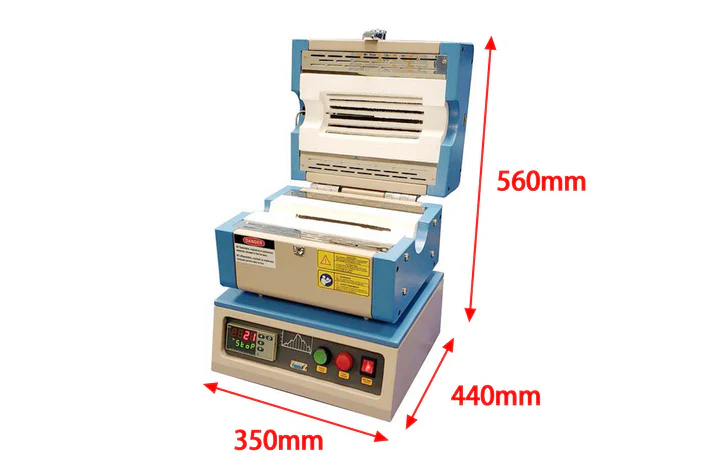
(Figure 1 — A compact split-tube furnace, showing the quartz process tube, insulated heating zone, and control unit integrated into a single benchtop instrument.)
Quartz tubes are popular in laboratory-scale furnaces because they are transparent, chemically inert, and easy to seal.
3.4 Temperature Measurement
Standard sensor: the thermocouple, based on the Seebeck effect.
A K-type (nickel-chromium) thermocouple is the most common choice for high-temperature work, reliably operating up to around 1250 °C and feeding a continuous signal to the controller.
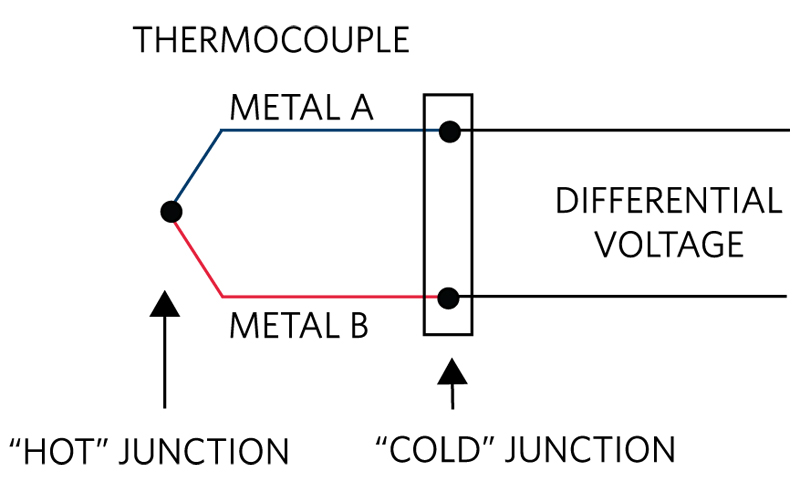
(Figure 2 — Working principle of a thermocouple: two dissimilar metal wires joined at a measuring junction produce a temperature-dependent voltage via the Seebeck effect.)
3.5 Control System
Decision-making layer: PID (Proportional–Integral–Derivative) control.
It adjusts heating power based on the current temperature error, its accumulated history, and its rate of change, and commonly supports programmable multi-segment heating profiles with data logging.
3.6 Ventilation and Exhaust
Manages gas flow: ports, sealing flanges, valves, and cooling fans.
This is essential for controlled-atmosphere work — inert gas, vacuum, or reactive gas — and also protects external electronics and speeds up cool-down between cycles.
4. Safety Systems
Because high-temperature furnaces concentrate significant thermal and electrical energy in a small space, safety systems are mandatory. Four safeguards recur across most designs: over-temperature protection; thermocouple-break detection; cooling-system alarms; and general electrical safety measures such as grounding and insulation monitoring for the high-current circuits that drive the heating elements.
Conclusion
High-temperature furnaces are, at their core, an engineering answer to a simple question: how do you generate, contain, and precisely control intense heat over long periods of time? The answer consistently involves the same six building blocks: a heat source, insulation, a container, a measurement system, a control system and ventilation. MTI Corporation designs and manufactures the full range of equipment needed to cover these six building blocks, from benchtop tube furnaces to specialized high-pressure, high-vacuum, and rapid-thermal-processing systems.
| Interested in Acquiring One of These Furnaces?
● Browse the full MTI catalogue: explore the complete range of furnaces, from benchtop tube furnaces to high-pressure, high-vacuum, and rapid-thermal-processing systems, at Website: www.mtixtl.com ● Get a personalized quote through ACCESSR: as MTI Corporation’s official distributor, ACCESSR can advise on the right furnace configuration for your application, arrange a demonstration, and manage your order from quote to delivery within Europe. Website: www.accessr-energy.eu Email: contact@accessr-energy.eu Phone: +33 (0)6 67 62 90 58 Feel free to reach out with your target temperature, atmosphere, and sample size — our team will be glad to recommend the furnace best suited to your project. |