


As alloy design becomes increasingly driven by combinatorial screening and AI-assisted workflows, reproducibility and dataset consistency are becoming just as important as melting capability itself.
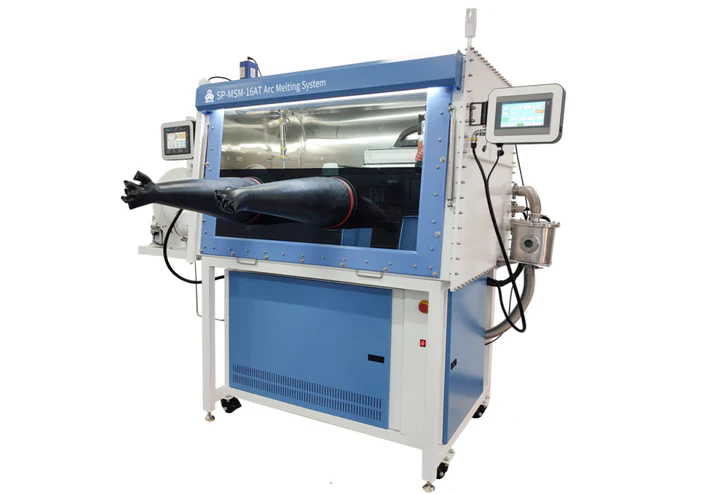
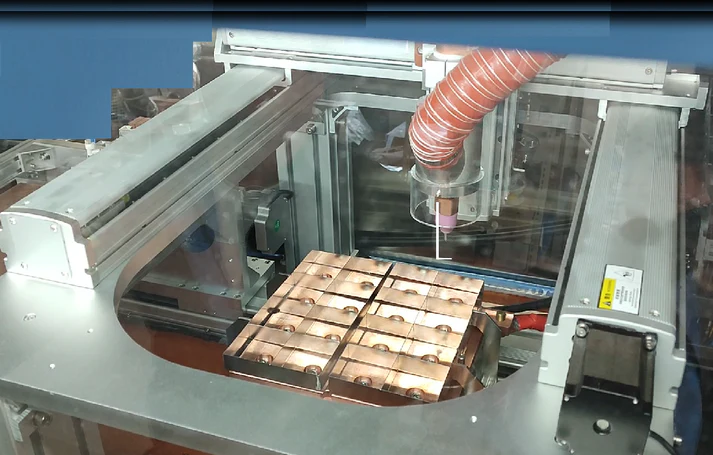
With the increasing demand for synthesis platforms capable of producing large compositional datasets with high consistency and minimal operator intervention, MTI Corporation has developed the SP-MSM-16AT 16-Cavity Automatic Arc Melting System, an autonomous high-throughput arc melting platform designed specifically for advanced alloy research.
The SP-MSM-16AT enables a new workflow for combinatorial metallurgy and autonomous materials research, combining multi-sample synthesis, programmable repeated remelting, ultra-low oxygen processing and robotic integration capability.
Why Conventional Arc Melting Limits Modern Alloy Discovery
Conventional laboratory arc melters remain widely used for HEA synthesis, intermetallic alloys, magnetic materials, and refractory alloy preparation. However, traditional systems present several limitations in modern research environments:
- Low experimental throughput
- Manual flipping/remelting
- Inconsistent thermal history between samples
- Repeated chamber exposure
- Operator-dependent reproducibility
These limitations become increasingly significant in:
- Combinatorial alloy development
- Machine-learning-driven materials discovery
- Statistically robust experimental campaigns
A High-Throughput Solution for Alloy Screening
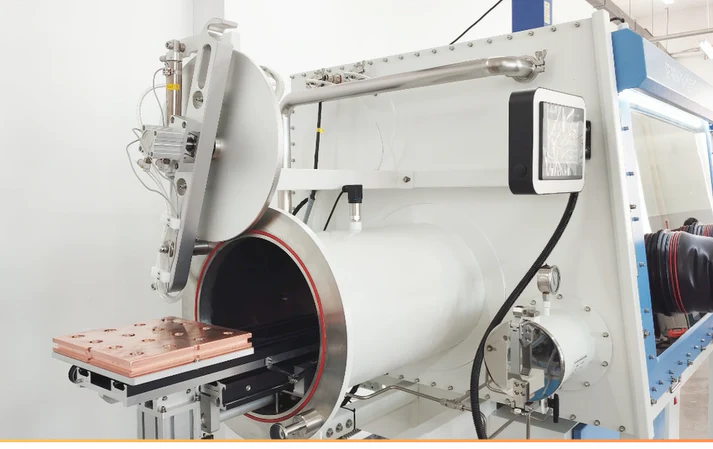
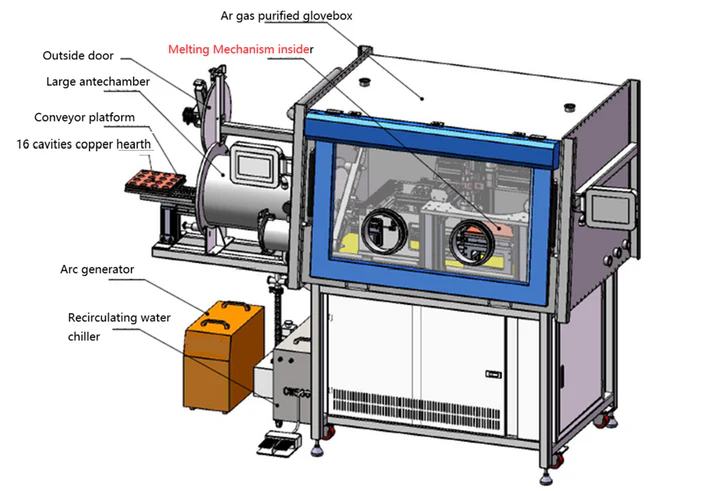
The SP-MSM-16AT addresses these challenges through a 16-cavity water-cooled copper hearth integrated within a fully automated arc melting platform. Researchers can synthesize up to 16 alloy compositions within a single automated cycle under identical atmospheric and thermal conditions. This design is particularly valuable for:
- Compositional screening studies
- Dopant optimization
- Phase-diagram exploration
- High-dimensional alloy systems
Programmable Automatic Flip Function
In high-throughput alloy screening, inconsistent remelting history can introduce hidden variability into experimental datasets, reducing the reliability of structure–property correlations and machine-learning models.
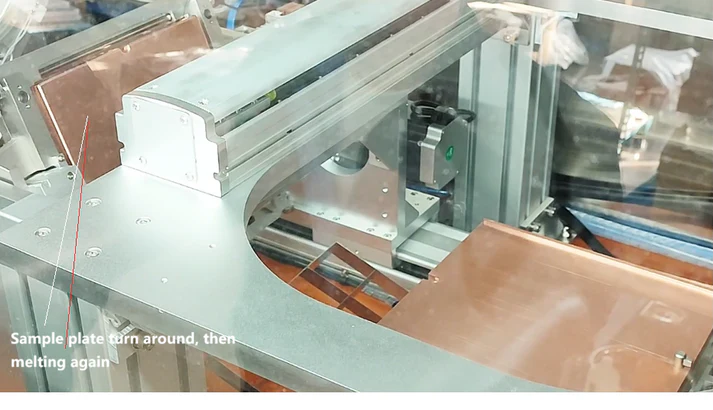
A major innovation of the system is the programmable flip-remelt mechanism, which allows automatic repeated remelting of all 16 samples up to 10 times without manual intervention.
Repeated remelting is essential in advanced alloy synthesis because it:
- Improves chemical homogeneity
- Reduces elemental segregation
- Promotes dissolution of refractory constituents
- Minimizes local compositional gradients
- Improves experimental reproducibility
This is especially important for systems containing W, Ta, Mo, Nb, rare-earth elements, or multiphase intermetallic compositions.
Automating the remelting process eliminates operator variability while ensuring identical homogenization history across all samples. For high-throughput alloy screening, this significantly improves dataset reliability and comparability.
Ultra-Low Oxygen Processing Environment
The complete arc melting system operates inside a glovebox integrated with an argon purification system capable of maintaining:
- O₂ < 1 ppm
- H₂O < 1 ppm
This ultra-clean environment is critical for oxygen-sensitive and reactive materials, including titanium alloys, zirconium alloys, magnesium-containing systems, rare-earth alloys and reactive refractory HEAs.
By minimizing oxidation and contamination, the platform enables:
- Improved alloy purity
- Better reproducibility
- More reliable structure–property correlation studies
Designed for Autonomous Materials Research
The SP-MSM-16AT was developed with autonomous and AI-driven laboratories in mind. The platform is compatible with robotic sample handling, AGV systems and automated characterization workflows. This enables integration into:
- Self-driving laboratories
- Autonomous metallurgy platforms,
- High-throughput experimental infrastructures
- Materials Genome Initiative programs
In these workflows, the arc melting system becomes part of a broader data-generation system capable of accelerating alloy discovery cycles.
Key Technical Specifications
- 16-cavity water-cooled copper hearth
- Fully automatic remelting function
- Programmable flip function (up to 10 cycles)
- Glovebox chamber dimension: 2715 L x 1130 W x 900 H (mm)
- Argon gas purification to ensure <1 ppm O₂/H₂O atmosphere
- Maximum melting temperature 3000 °C
- Water-cooled tungsten electrode
- Robotic or AGV integration readiness
Toward Data-Centric Metallurgy
As autonomous laboratories and AI-assisted alloy design continue to evolve, high-throughput synthesis platforms such as the SP-MSM-16AT may become essential infrastructure for next-generation metallurgy research.
For more information, please contact contact@accessr-energy.eu