


A recent study, titled Enhanced and tunable ferromagnetism in periodic-arrays of CVD-synthesized carbon films, reports the fabrication of tunable ferromagnetic carbon films through a combination of chemical vapor deposition (CVD), lithographic patterning, and defect engineering. A central component of the experimental methodology is the MTI CVD furnace (OTF-1200X-PEC4LV), which serves as the foundational platform for material synthesis and directly determines the structural and magnetic properties of the resulting films.
Preparation process of tunable ferromagnetic carbon film
-
Carbon Film Growth via MTI CVD Furnace
The carbon films were synthesized using adamantane as a solid precursor. The precursor was vaporized at approximately 100 °C and transported into the high-temperature reaction zone, where substrates were maintained at 1150 °C under an argon atmosphere. Within the MTI CVD furnace, thermal decomposition of adamantane produced reactive carbon species that nucleated and formed thin films on quartz substrates.
The furnace plays several critical roles:
- High-temperature capability (up to 1200 °C): Enables efficient precursor cracking and formation of sp²-rich carbon networks.
- Controlled inert atmosphere: Prevents oxidation and allows precise defect formation rather than complete graphitization.
- Stable thermal and gas-flow control: Ensures uniform film deposition across the substrate.
- Gas-phase transport mechanism: Facilitates conformal coating and homogeneous growth.
Importantly, the CVD process essentially introduces structural defects such as dangling bonds, which act as localized magnetic moments and are the primary origin of ferromagnetism in the material.
-
Post-Growth Structuring and Defect Engineering
Following deposition, periodic micro-scale arrays were fabricated using electron beam lithography (EBL) combined with oxygen plasma etching. This step defines the lateral dimensions of the carbon structures and increases edge-related defect density.
-
Environmental Modulation (Humidity Control)
To further probe tunability, the samples underwent cyclic treatments involving water exposure and thermal annealing. Water adsorption passivates dangling bonds, reducing magnetization, while annealing partially restores the magnetic state. This demonstrates reversible environmental control over magnetic properties.
-
Characterization Techniques
The films were characterized using:
- Vibrating Sample Magnetometry (VSM) for magnetic hysteresis
- Magnetic Force Microscopy (MFM) for spatial magnetic mapping
- Raman spectroscopy for defect and structural analysis
- Atomic Force Microscopy (AFM) for morphology and thickness
Key Role of the MTI CVD Furnace
The MTI CVD furnace is not only a synthesis tool but a deterministic factor in defining material functionality. Its precise control over thermal conditions and gas-phase reactions enables:
- Formation of defect-engineered carbon films
- Tunable magnetic properties via controlled growth conditions
- High reproducibility and uniformity necessary for microfabrication
- Without this level of control, the generation of stable, defect-mediated ferromagnetism in metal-free carbon systems would not be achievable.
Specifications of CVD Furnace OTF-1200X-PEC4LV
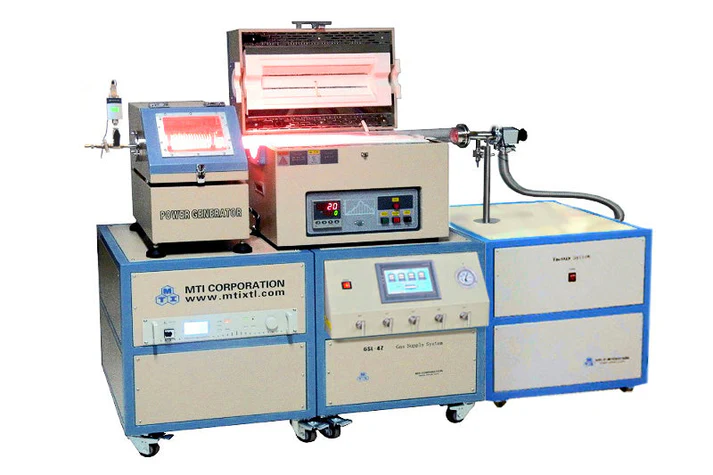
Split Tube furnace
- Working Temperature: 1200°C for < 60 minutes. 1100°C for continuous heating
- 440 mm heating zone and 150 mm constant temperate zone
- +/- 1 ºC temperature accuracy
- 30 segments programmable temperature controller
Plasma RF Power Supply
- Output Power: 5 -300W adjustable with ± 1% stability
- RF frequency: 13.56 MHz ±0.005% stability
- Reflection Power: 200W Max.
Vacuum Pump
- Rotary Vane Vacuum Pump (7.8 CFM -240 L/m)
- vacuum pressure 10-2 torr
- Digital vacuum pressure gauge
Mass Flowmeter
- 4-channeled Gas Mixing
- 316 stainless steel valves
- Gas mixing tank : Φ80X120mm
Conclusion
In summary, the experimental strategy integrates CVD growth, micro-structuring, and environmental modulation to realize tunable ferromagnetism in carbon films. The MTI CVD furnace is central to this approach, as it governs the formation of defect-rich carbon structures that underpin the observed magnetic behavior, making it indispensable for both material synthesis and property engineering.
Reference: https://doi.org/10.1016/j.cartre.2026.100622