


The recent study “Atom probe tomography of the Fe₂AlB₂ MAB phase” presents the first atom probe tomography (APT) investigation of bulk Fe₂AlB₂, a layered MAB phase, and evaluates how reliably APT can deliver atomic-scale structural and compositional information in this complex boride ceramic. Particular attention is given to the challenges associated with boron quantification and the interpretation of crystallographic information.
Using MTI high-temperature furnaces, researchers successfully synthesized and densified Fe₂AlB₂ into dense bulk pellets with high phase purity (~97 at.% Fe₂AlB₂). This well-controlled material provided a robust foundation for advanced characterization and preparation of APT specimens.
Key Findings
- The study confirms that bulk Fe₂AlB₂ suitable for APT analysis can be synthesized and validated using conventional structural and chemical characterization techniques, ensuring that APT tips originate from an essentially phase-pure MAB matrix.
- APT reconstructions appear largely homogeneous for Fe, Al, and B at the probed scale, but quantitative interpretation is strongly limited by element-dependent multiple-hit effects, particularly for boron.
- The measurements show very high multiple-hit rates and abundant B-containing molecular ions, leading to a systematic underestimation of boron and a strong dependence of the measured Fe/Al ratio on laser energy and evaporation field.
- Despite these limitations, crystallographic poles and atomic planes are clearly resolved, with Al layering more readily visible than Fe and B; however, plane-by-plane chemistry and chemical ordering cannot be reliably recovered under the conditions used.
- X-ray diffraction and SEM-EDS are used primarily to verify phase purity, texture, and overall composition, emphasizing the importance of correlative approaches when interpreting APT data for MAB phases.
Role of the GSL-1800X-S60
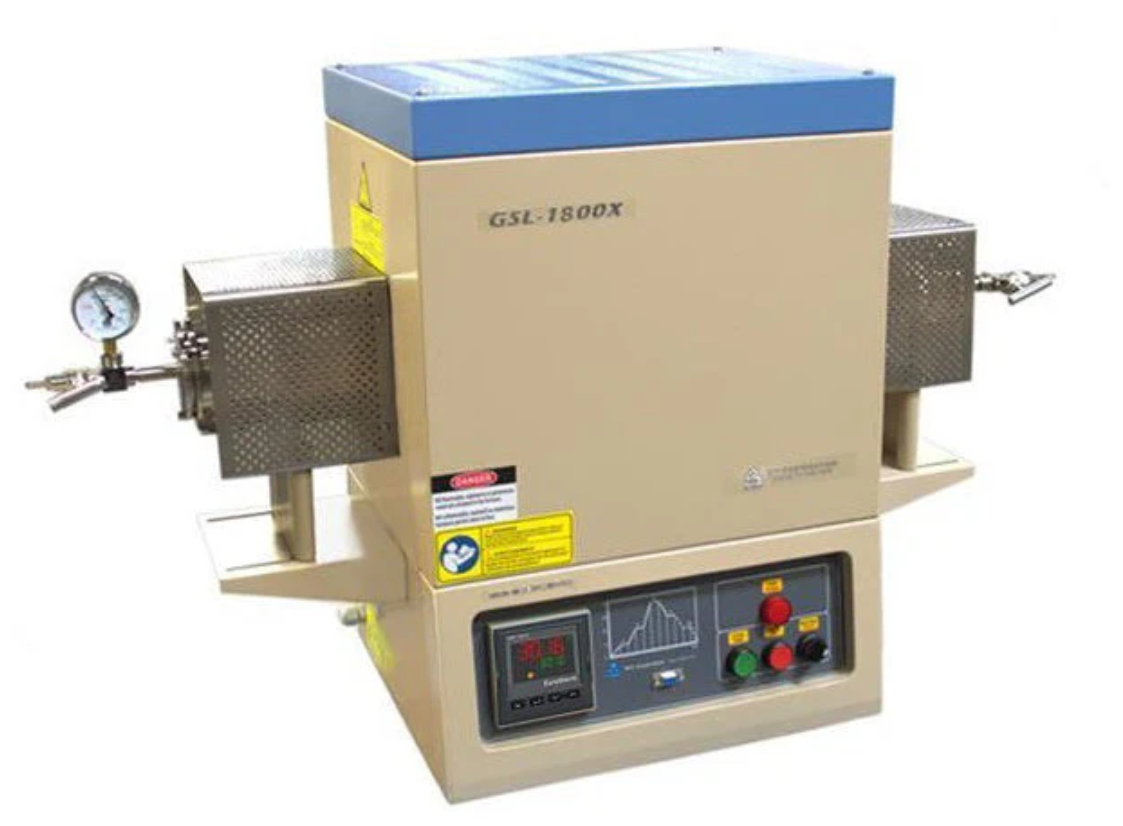
The GSL-1800X-S60 high-temperature tube furnace is used to synthesize the Fe₂AlB₂ phase by reacting Fe–Al–B pellets at 1200 °C under argon.
Why GSL-1800X-S60?
- Provides the high temperature needed for Fe₂AlB₂ phase formation
- Offers controlled atmosphere (Ar or vacuum) to prevent oxidation of Al and B
- Ensures sufficient reaction time for atomic diffusion and formation of the layered MAB structure
Result:
A high-quality Fe₂AlB₂ precursor with controlled phase formation, ready for densification.
Key Features
- High-temperature synthesis: Up to 1800 °C, ideal for forming complex materials like Fe₂AlB₂.
- Controlled atmosphere: Operates under vacuum or inert gas to prevent oxidation of sensitive elements.
- Uniform heating: 60 mm alumina tube with MoSi₂ elements ensures consistent phase formation.
- Benefit for research: Produces phase-pure precursors ready for densification and advanced characterization.
Role of the OTF-1500X-VHP4
The OTF-1500X-VHP4 hot-press furnace is used to densify the synthesized Fe₂AlB₂ powder by applying high temperature and pressure.
What the OTF-1500X-VHP4 does:
- Densifies the material through hot pressing (heat + pressure)
- Eliminates porosity and microcracks
- Stabilizes the microstructure and mechanical strength
Why this matters for APT:
- Enables reliable APT specimen preparation without fracture
- Delivers high-quality, artefact-free atomic-scale data
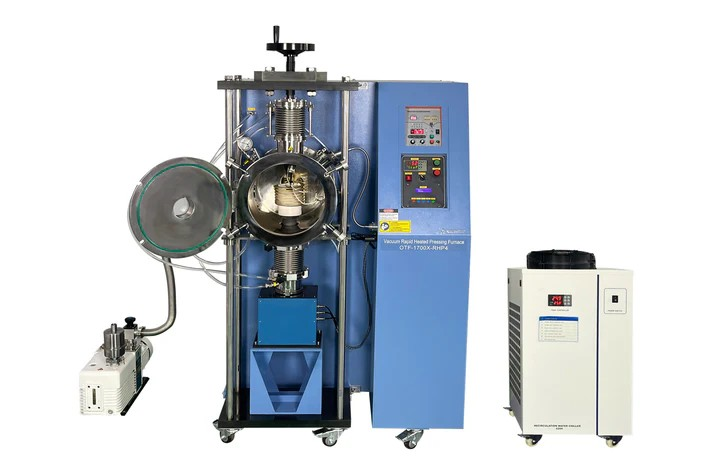
OTF-1500X-VHP4 is no more produced by MTI
similar product : 2000ºC Vacuum Rapid Heated Pressing Furnace up to 100 MPa with Graphite Die – OTF-1700X-RHP4
Key Features
- Hot pressing capability: Combines high temperature (up to ~1700 °C) and mechanical pressure (up to 5 T) to densify powders and compact materials quickly.
- Controlled atmosphere: Operates under vacuum or a protective gas environment, reducing oxidation and contamination during processing.
- Rapid and uniform heating: Uses induction heating to provide fast, efficient, and uniform temperature distribution.
- Benefit for research: Enables fabrication of dense, high-quality samples with controlled microstructure for advanced materials characterization and testing.
The GSL-1800X-S60 forms the phase; the OTF-1500X-VHP4 perfects the structure—together enabling advanced atomic-scale characterization.
Contact us at contact@accessr-energy.eu for any questions.