


“Nickel-Doping Modified Interface Synergized With Hollow Confinement Constructs Highly Stable Silicon Anodes for Long Cycling Lithium-Ion Batteries”: A recent study reports a Ni/HSi@C composite anode, defined as Ni-doped hollow silicon (HSi) particles coated with a conductive carbon shell (C). This architecture combines hollow confinement with Ni-induced interfacial engineering to achieve both high specific capacity and outstanding cycling stability in lithium-ion batteries.
Ni is incorporated into hollow SiO₂ spheres, magnesiothermically reduced to porous hollow silicon, and coated with a resorcinol–formaldehyde-derived carbon layer. The hollow structure directs volume expansion inward while the carbon shell maintains integrity and conductivity. Ni doping partially amorphizes silicon, promotes Si–O–C bonds, reduces charge-transfer resistance, lowers Li⁺ diffusion barriers, and enhances pseudocapacitive charge storage.
Ni/HSi@C delivers ≈1850 mAh g⁻¹ at 0.2 A g⁻¹, maintains 1318 mAh g⁻¹ after 1000 cycles at 1 A g⁻¹ (essentially no decay post-activation), and shows excellent rate capability. Interfacial analyses confirm a thinner, LiF-rich, stable SEI with suppressed electrolyte decomposition versus undoped HSi@C.
A Ni/HSi@C‖LiFePO₄ pouch cell (no pre-lithiation, realistic loadings) achieves 36.2 mAh at 0.1 C after 100 cycles (74% retention) and 379 Wh kg⁻¹ energy density, demonstrating strong potential for next-generation Si anodes.
Battery Assembling Equipment Overview
To fabricate and evaluate such advanced electrodes and pouch cells, the following equipment is typically employed:
MSK-PCV-300 – Planetary Vacuum Centrifugal Mixer
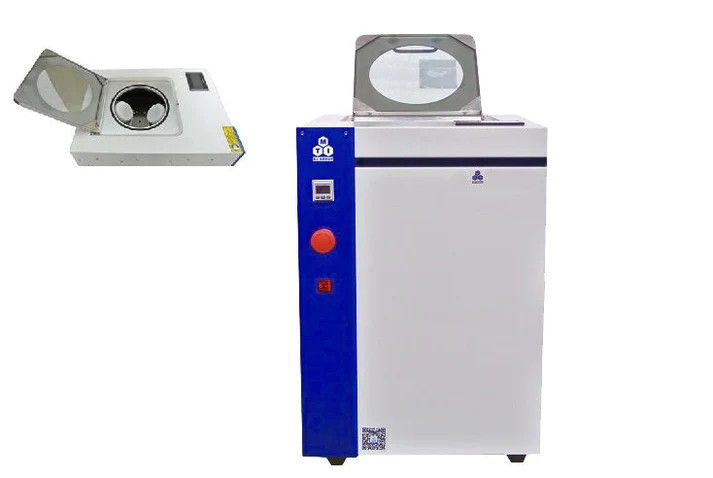
- Function: Mixes and deaerates battery slurries, pastes, and powders under vacuum
- Mixing method: Planetary centrifugal motion (no mixing blades → low contamination)
- Capacity: 2 × 300 mL containers
- Centrifugal acceleration : ≤ 600 g
- Viscosity : ≤ 80 000 Pa·s
- Ultimate Vacuum : – 95 kPa
- Platen (revolution) Motion : 600 rpm – 2,000 rpm (adjustable)
- Container (rotation) Motion : 360 rpm – 1,200 rpm (fixed at 0.6X of the revolution speed)
MSK-AFA-EI200 – Compact Roll-to-Roll Coater
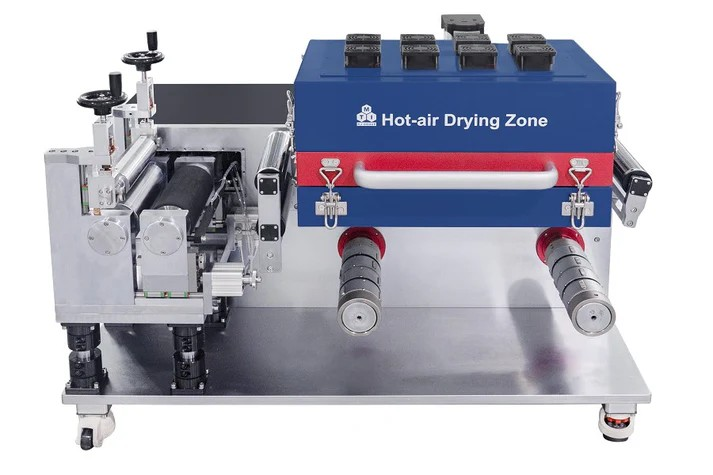
- Function: Roll-to-roll coater with 6 optional heads
- Max coating width: ~ 160 mm
- Coating method: Doctor Blade / Slot-Die / Reverse Comma Blade / Micro-Gravure / Slot-Die + Doctor Blade / Slot-Die + Reverse Comma Blade
- Heating Method : Forced convection hot air / IR + UV
- Convection chamber : 500 mm Length
- Drying Temperature : 130 °C
- Temperature Accuracy : ± 1 °C
MSK-2300A – Hydraulic Balanced Electric Roller
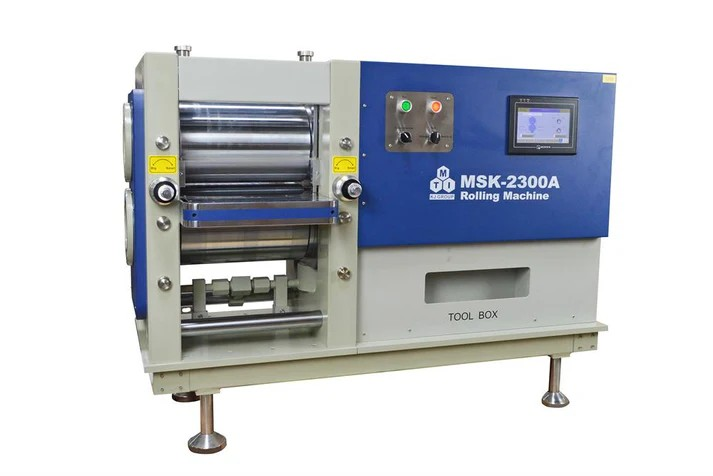
- Function : Precision electric calender with adjustable hydraulic pressure
- Roller Material Hardness : 60 – 62 HRC
- Hardness of Rolled Material : < 50 HRC
- Effective Rolling Width : < 250 mm
- Rolling Gap : ≤ 1.5 mm with tolerance 0.003 mm
- Pressure Load : ≤ 25 T
- Compressed Air : Gas Cylinder or Air Compressor is required
MSK-800W – Ultrasonic Welder
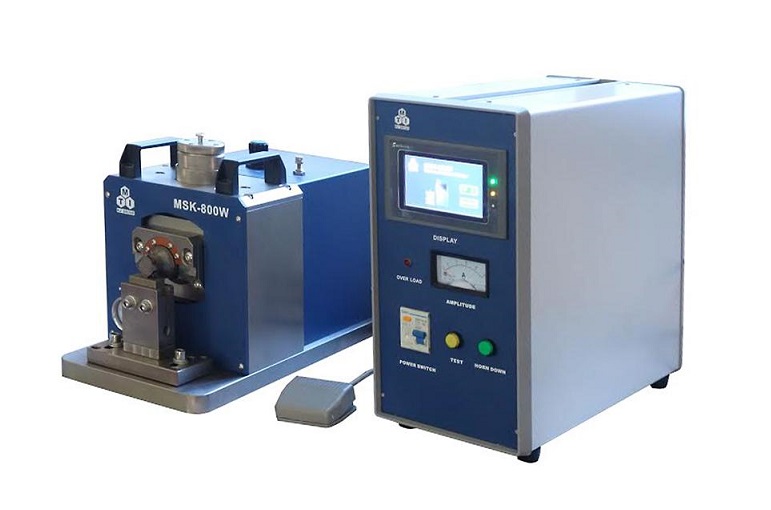
- Function : ultrasonic metal welder designed for welding stacked electrode or tab welding
- Power : 800 W
- Ultrasonic Frequency : 40 kHz
- Welding Area : 4 mm (L) x 4 mm (W)
MSK-PN140 – Pneumatic Heat Sealing Machine
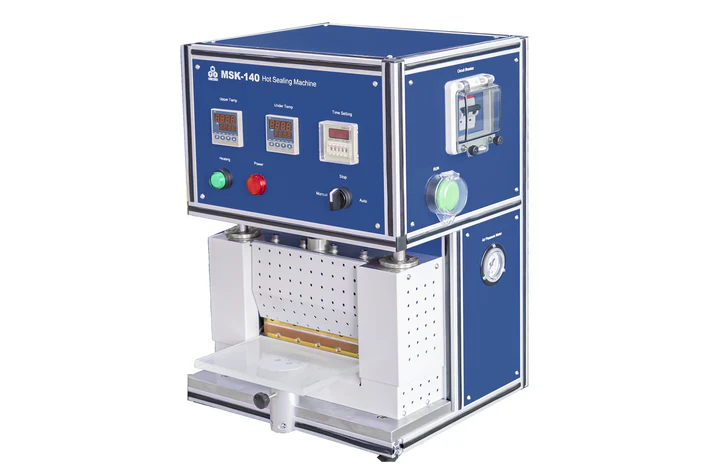
MSK-PN140 now replaced by the updated MSK-140/MSK-140L
- Function : Top and side pouch cell case pre-sealing
- Power : 900 W / 1200 W
- Sealing Thickness : 0 – 0.5 mm
- Sealing pressure : 0 – 99 psi adjustable
- Compressed Air : Gas Cylinder or Air Compressor is required
MSK-115A-L – Secondary Vacuum Final Sealer
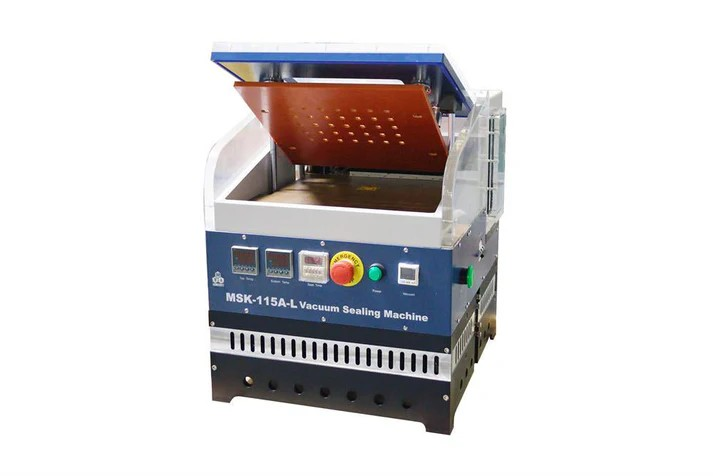
- Function : Vacuum Sealer for Pouch Cell Piercing and Final Sealing
- Pouch Cell Size : 340 mm (L) x 340 mm (W) x 12 mm (T)
- Sealing Blade Material : Copper with Thermal Conductive Layer
- Sealing Blade Dimensions : 340 mm (L) x 6 mm (W)
- Sealing Temperature : 50 – 250 °C
- Piercing : 6 Built-in piercing needles
- Glove-box Compatibility : Yes
- Pneumatic Chamber Lid & Sealing Function : Air Compressor or Gas Cylinder required
- Sealing Pressure : 0 ~ 100 psi ajustable
Battery Testing System
The LAND battery testing system is a multi-channel potentiostat platform designed for precise control and monitoring of charge–discharge behavior in research cells.
It enables:
- Programmable Constant Current Charge (CC), Constant Voltage Charge(CV), and Constant Current Constant Voltage Charge (CC–CV) protocols for coin and pouch cells,
- Measurement of voltage, current, capacity, coulombic efficiency, and cycle life, etc.
- Long-term automated data logging across multiple independent channels.
CT3002A – Micro current range tester
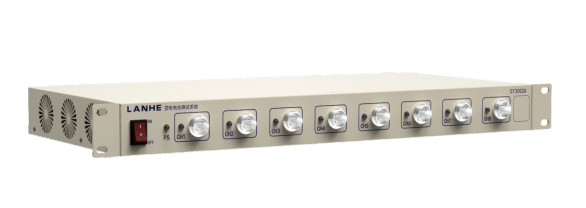
- Voltage Range : 5 V
- Current Range : Current 1 : 1 mA / 2 mA / 5 mA / 10 mA (Options) ; Current 2 : 10 mA / 20 mA / 50 mA / 100 mA (Options)
- Working Mode : Constant current charge & discharge, constant voltage charge & discharge, constant power charge & discharge, constant resistance discharge, CC-rate, DC-rate, Direct Current Internal Resistance, Rest
- Channels : 1 / 2 / 4 / 8 (Options)
- Input Impedance : ≥ 1 MΩ
- Output : Four electrodes (Support tri-electrode test)
- Voltage Accuracy : ± 0.05 % FS
- Current Accuracy : ± 0.05 % FS
- Resistance Accuracy : ± 0.1 % FS
- System Time Accuracy : ± 1 s (No accumulated error)
For more information, please contact contact@accessr-energy.eu