


A recent study entitled “B/N-doped carbon nano-onions as nanocarriers for targeted breast cancer therapy” reports the fabrication of boron/nitrogen co-doped carbon nano-onions (BN-CNOs) as the core scaffold for a targeted nanocarrier system for doxorubicin (DOX) delivery. The experimental workflow integrates high-temperature structural transformation, controlled oxidation purification, polymer functionalization, drug loading, physicochemical characterization, and in vitro biological validation. Among these steps, the thermal treatment performed using two furnaces from MTI Corporation is foundational to the structural and functional quality of the final nanomaterial.
BN-CNO Synthesis: Role of High-Temperature Thermal Engineering
-
Structural Transformation in the GSL-1750X-KS Tube Furnace
The first critical step in BN-CNO synthesis involves the thermal conversion of detonation nanodiamonds (DNDs) into carbon nano-onions. This transformation was performed in a GSL-1750X-KS tube furnace under the following conditions:
- Temperature: 1650 °C
- Atmosphere: Helium (inert gas)
- Duration: 1 hour
The tube furnace provides high temperature stability, uniform thermal distribution, controlled inert atmosphere (He flow), to ensure homogeneous graphitization and dopant incorporation. Under these conditions the nanodiamond cores are reconstructed into concentric multilayer graphitic shells.
-
Selective Oxidative Purification in the KSL-1200X-J Box Furnace
Following graphitization, a second thermal treatment was performed using the KSL-1200X-J box furnace under air:
- Temperature: 450 °C
- Atmosphere: Ambient air
- Duration: 4 hours
This furnace provides stable medium-temperature oxidation conditions, uniform ambient heating and precise temperature control for selective carbon removal. The previous treatment may generate residual amorphous carbon impurities. At 450 °C in air the amorphous carbon oxidizes preferentially while the multilayer BN-CNO structures remain stable. This selective oxidation step enhances crystallinity, improves surface consistency and optimizes subsequent dispersion and drug loading.
Critical Role of the Furnaces to System Performance
The nanocarrier’s final properties are directly linked to the precision of the two-stage thermal process. Impact on Drug Loading:
- High sp² carbon content enables efficient π–π stacking.
- Controlled defect density prevents excessive aggregation.
- Stable dopant incorporation modifies electronic structure.
Impact on Dispersibility:
- Removal of amorphous carbon improves colloidal stability.
- Controlled surface composition enhances HA-DMPE anchoring.
Impact on Biological Performance:
- Structural integrity supports high drug loading (up to ~48% DLC).
- pH-responsive release is enabled by stable surface chemistry.
- Reduced off-target toxicity results from controlled release kinetics.
Thus, the furnaces determine the structural platform upon which all subsequent biological performance depends.
Characteristics of the MTI Furnaces in This Study
1. GSL-1750X-KS
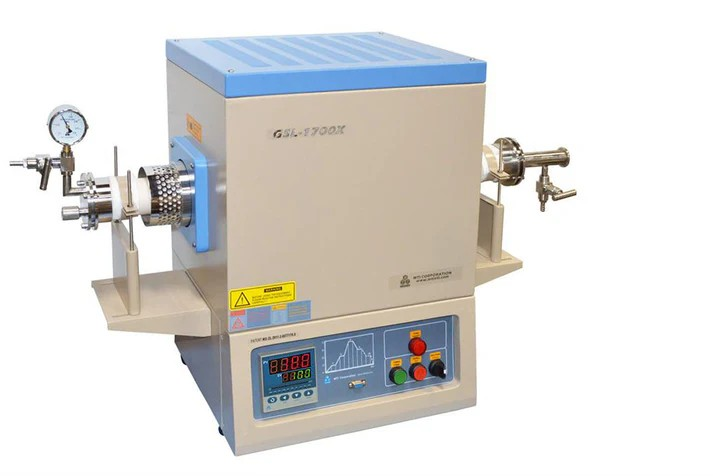
Working Temperature: Max. 1750 °C < 2 hours, Continuous: 1700 °C
Max. Heating Rate: 5 °C/min
Heating Zone: 457 mm
Constant Temperature Zone: 150 mm
Temperature Control Accuracy: +/- 1 ºC
Processing Tube: High purity Al2O3 ceramic, 54mm ID x 60 mm OD x 1000 mm length
Vacuum Level: 0.05 torr by the mechanical pump, 10^-5 torr by molecular pump
Our current version is GSL-1750X-S
2. KSL-1200X-J
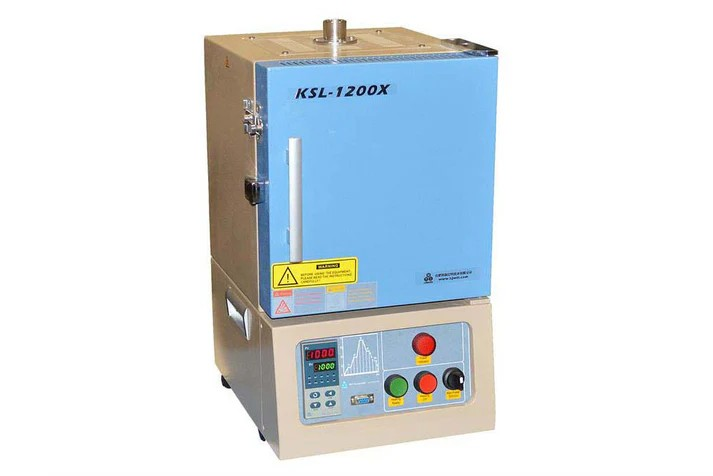
Working Temperature: Max. 1250 °C < 1 hour, Continuous: 1200 °C
Max. Heating Rate: 30 °C/min
Temperature Uniformity: +/- 1.0 °C
Temperature Control Accuracy: +/- 1 °C
Processing Cahmber: High purity alumina fiber insulation, 150mm(W) x 155mm(H) x 180mm(D)
For more information, please contact us via https://www.accessr-energy.eu/en/ or contact@accessr-energy.eu
Reference
B/N-doped carbon nano-onions as nanocarriers for targeted breast cancer therapy
DOI: 10.1039/d4nr04990j