


Researchers working on biomass valorization and biofuel development face a major analytical challenge: bio-oil produced by fast pyrolysis contains thousands of highly complex molecular species that are difficult to characterize accurately. To obtain reliable Fourier Transform Ion Cyclotron Resonance Mass Spectrometry (FT-ICR MS) data, the quality and reproducibility of the pyrolysis process are critical. In a recent study on beechwood pyrolysis bio-oil characterization, researchers used the MTI OTF-1200X-S-FB fluidized bed reactor to generate highly representative bio-oil samples suitable for ultrahigh-resolution petroleum omics analysis.
Experimental Procedure
Bio-oil Production Using MTI Fluidized Bed Reactor
The bio-oil was produced via fast pyrolysis of beechwood pellets in a fluidized bed reactor (MTI Corporation, OTF-1200X-S-FB). This reactor plays a critical role in ensuring controlled and reproducible thermochemical conversion.
Key operating conditions include:
- Temperature: 500 °C
- Atmosphere: Nitrogen (1 L/min) to maintain oxygen-free conditions
- Feeding rate: 0.5 g/min (total 40 g biomass)
- Residence time: 4–6 seconds
- Bed material: Sand to promote fluidization
The reactor system integrates a fluidized reaction zone for efficient heat transfer, a cyclone separator for removing entrained char particles and a condenser (−5 °C) for rapid recovery of liquid bio-oil. Under these conditions, biomass undergoes rapid depolymerization, producing a mixture of condensable vapors (bio-oil), non-condensable gases, and solid char.
Analytical Method
The collected bio-oil was dissolved in methanol and analyzed using FT-ICR MS equipped with an ESI source operating in both positive and negative modes. Data processing included molecular formula assignment, compound class distribution, double bond equivalent (DBE) analysis, and Van Krevelen diagram interpretation.
Key Findings
- Over 4000 molecular formulas were identified in ESI positive mode, compared to ~1000 in negative mode
- Oxygenated compounds dominate the composition (>80%)
- Positive ESI mode provides broader molecular coverage, including nitrogen-containing species
- Negative mode preferentially detects more unsaturated compounds
These results demonstrate that ionization mode significantly affects the observable chemical space, with positive mode offering more comprehensive characterization.
Role and Performance of the MTI Fluidized Bed Reactor
The MTI fluidized bed reactor is essential to the success of this study due to its superior thermal and hydrodynamic characteristics:
- Rapid and Uniform Heat Transfer
The fluidized bed ensures intense mixing between sand particles and biomass, enabling
- Fast heating rates
- Homogeneous temperature distribution
- Minimization of thermal gradients
This is crucial for promoting fast pyrolysis, which maximizes liquid bio-oil yield.
- Controlled Reaction Environment
The continuous nitrogen flow provides a strictly inert atmosphere, preventing oxidation or combustion. This ensures that the process remains purely pyrolytic and the chemical integrity of intermediate products is preserved.
- Short and Controlled Residence Time
The fluidization regime allows precise control over vapor residence time (4–6 s), which limits secondary cracking reactions and preserves oxygenated and high-molecular-weight species.
- Impact on Bio-oil Composition
The reactor conditions directly influence the resulting bio-oil, which is characterized by:
- High molecular complexity (>4000 assigned formulas in ESI+)
- Predominance of oxygenated compounds (>80%)
- Significant contributions from lignin-derived structures
Thus, the MTI reactor enables the generation of a representative and chemically rich bio-oil, suitable for advanced petroleum omics analysis.
Features of Fluidized Bed Furnace OTF1200XSFB
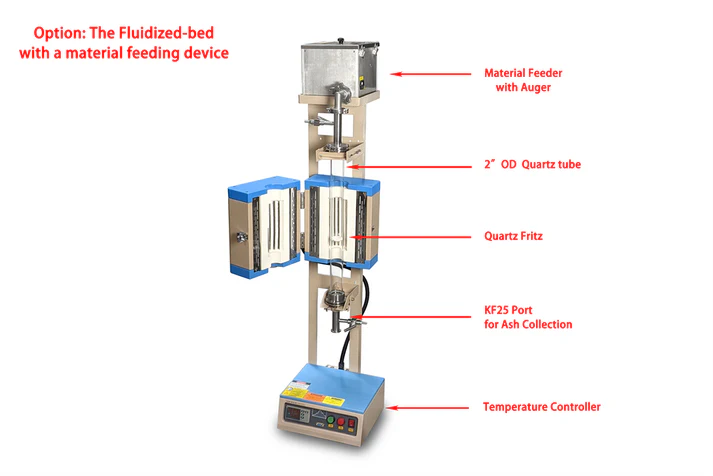
- Temperature: 1100°C
- Continuous Temperature: < 1000°C
- Heating Rate: 20°C/min
- Heating Zone Length: 200mm
- Constant Temperature Zone: 60mm (+/-2°C)
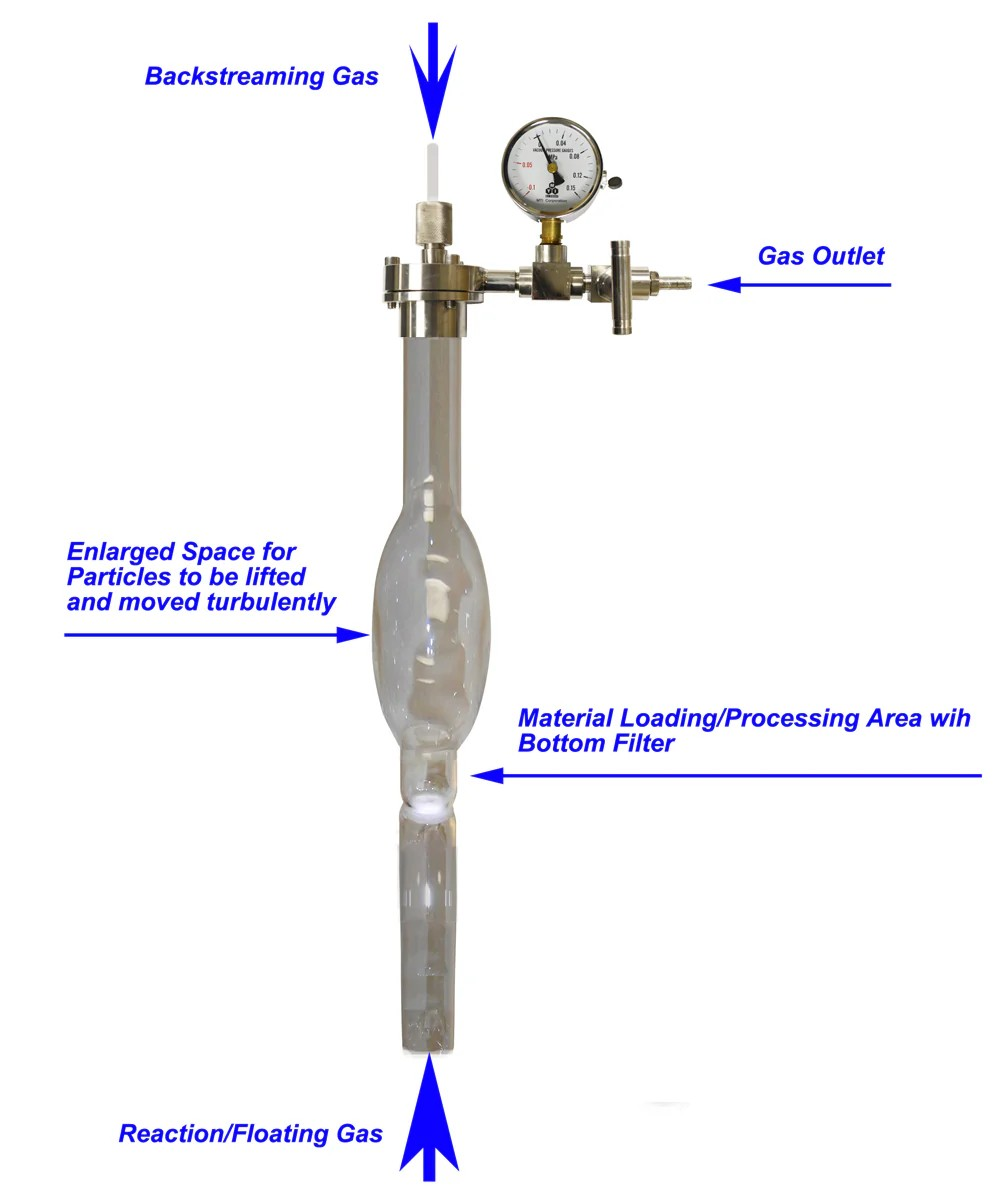
- Quartz tube with bottom frit and enlarged space
- Tube Diameter: Two Ends 25ODx 22 ID (mm); Central 50O.D. x 44 I.D. (mm)
- Fluidized Zone Diagram
Conclusion
This study highlights the importance of combining advanced analytical techniques with well-controlled material preparation. The MTI fluidized bed reactor plays a pivotal role by enabling fast pyrolysis under optimized thermal and hydrodynamic conditions, producing a highly complex and representative bio-oil. This, in turn, allows FT-ICR MS to fully exploit its ultrahigh resolution capabilities.
Overall, the integration of a high-performance fluidized bed reactor with petroleum omics analysis provides a robust framework for understanding and optimizing biomass-derived fuels and chemicals.
References
https://doi.org/10.1051/matecconf/202540701001